Tampilkan postingan dengan label Audi. Tampilkan semua postingan

Senin, 16 Januari 2012

2012 Audi A6 Allroad Quattro

Engine 3 liter TFSI V6, Aspiration supercharged, Torque 325 lb-ft, HP 310 hp, HP/Liter 103.3 hp per liter, 0-62 mph 5.9 seconds, Top Speed 155 mph (electronically limited).

The new Audi A6 allroad – the Avant for any kind of road
• Successful model completes the A6 model series
• Advanced powertrain technology with turbocharging and direct fuel injection
• Fuel consumption reduced by as much as 20 percent

The first two generations of the allroad quattro from the years 2000 and 2006 were winners, and Audi hopes to build on this success with the third generation. Universally talented, the new A6 allroad quattro extends the range of uses for the A6 Avant because when the asphalt ends, it just keeps on driving. Performance has improved and fuel consumption has been reduced by as much as 20 percent compared with the previous model.
Body and exterior design
The new A6 allroad quattro is 4.94 meters (16.21 ft) long, 1.90 meters (6.23 ft) wide and 1.47 (4.82 ft) meters tall, making it a few millimeters bigger than the Avant. It follows the Audi ultra lightweight construction principle familiar from the sedan, with aluminum components making up roughly 20 percent of its body. Total vehicle weight has been reduced by as much as 70 kilograms (154 lb) compared with the previous model.

The Audi A6 allroad quattro has a sportily distinctive road stance. It features balanced proportions, sharp lines delineate taut surfaces and the roof line flows into flat D-pillars. Audi offers progressive LED technology as an option for the headlights and tail lights. The xenon plus headlights can be combined with adaptive light, which ensures that the road is always properly illuminated for the situation at hand.

The body of the new A6 allroad quattro sits six centimeters (2.36 in) higher than that of the A6 Avant. Setting it apart are, in particular, the trim strips on the side sills, the more widely flared fenders and the single-frame grille with vertical slats. Stainless steel covers protect the underbody at the front and rear of the car, and the exhaust system ends in two large, flattened tailpipes. The roof rails are mounted on double bars.

The wheel well edges, the bumpers and the sills are painted in a contrasting color. Audi also offers a full paint finish in combination with the optional aluminum exterior package. The color Java Braun is available exclusively for the new A6 allroad quattro.

Interior and luggage compartment
The interior of the Audi A6 allroad quattro offers plenty of space thanks to the long wheelbase of 2.91 meters (9.55 ft). It features a lean, elegant design, exemplarily clear ergonomics and superior workmanship. A function that depicts the car’s pitch has been added to the MMI operating system, the soft keys of which are gleaming aluminum. MMI comes as standard, as does the onboard computer with efficiency program. A comprehensive package of restraint systems helps to mitigate the consequences of an accident.

Visual cues differentiating the A6 allroad quattro include the carpeting and the instrument panel, which are black throughout. Other refined details include the interior color Santos Brown and the optional aluminum inlays. The door sill trims are also made of aluminum and are emblazoned with “allroad.”

The luggage compartment of the new A6 allroad quattro has a capacity of 565 liters (19.95 cu ft). Latches in the luggage compartment make it easy to fold down the rear seats, increasing luggage capacity to 1,680 liters (59.33 cu ft). Standard equipment features underscore the practical character of the new model – a rail system with an included load-securing kit for dividing the luggage compartment as needed, tensioning straps on the left wall and a double loading floor.
Equipment and Audi connect
Audi offers a broad choice of options for the new A6 allroad quattro. The head-up display projects important information onto the windshield. Ambient lighting bathes the interior with subtle LED light, and the widely adjustable deluxe front seats are optionally available with a ventilation and massage function. Additional highlights include four-zone automatic air conditioning, a panoramic glass roof and the convenience key, which can stay in the driver’s jacket pocket.

Topping the modular range of infotainment options is the hard drive-based navigation system MMI Navigation plus with touchpad operation (MMI touch) and whole-word voice control. Its power-retractable eight-inch monitor displays extremely sharp, high-contrast images. The Bang & Olufsen Advanced Sound System boasts 15 speakers.

The new A6 allroad quattro is also state of the art when it comes to connection technology. The optional Bluetooth car phone online connects it to the Internet via UMTS, and a WLAN hotspot lets the passengers surf and e-mail. Tailored services for the driver, such as the all-new Audi traffic information online or Audi music stream web radio, are delivered right to the car. Attractive services from Google, including Google Earth, Google Street View and voice-activated POI search, are also available.
Driver assistance systems
The Audi assistance and safety systems lend even more confidence to driving. The radar-based adaptive cruise control with stop & go function always keeps the new A6 allroad quattro at the proper distance from the car ahead. At speeds below 30 km/h (18.64 mph), the system initiates maximum braking in the event of an impending collision. ACC stop & go works closely together with the Audi pre sense safety system, which is available in a number of configurations.

Audi active lane assist helps the driver to maintain the lane; Audi side assist helps when changing lanes. The night vision assistant with marking of detected persons reduces the stress of driving in the dark. The driver information system with rest recommendation function detects when the driver is getting tired and recommends taking a rest.

A variety of high-end systems help take the stress out of parking. The park assist system with 360° display takes over the steering; the parking system plus with 360° camera provides good vision in all directions. Four small wide-angle cameras record images of the vehicle’s immediate surroundings, which can then be displayed from a variety of perspectives on the MMI monitor.
Drivetrain
The new A6 allroad quattro is available with a choice of four powerful and highly cultivated V6 engines – one TFSI gasoline engine and three TDI units. All are three-liter engines with turbocharging and direct injection. They make use of important technologies from the Audi modular efficiency platform – the start-stop system and innovative thermal management. Their fuel consumption has been reduced by as much as 20 percent compared with the previous model.

The 3.0 TFSI, which is boosted by a mechanically driven compressor, produces 228 kW (310 hp) and 440 Nm (324.53 lb-ft) of torque. It accelerates the A6 allroad quattro from zero to 100 km/h (62.14 mph) in 5.9 seconds on the way to a electronically limited top speed of 250 km/h (155.34 mph). It consumes 8.9 liters of fuel per 100 km (26.43 US mpg).

The three variants of the 3.0 TDI produce 150 kW (204 hp), 180 kW (245 hp) and 230 kW (313 hp); torque values are 450, 580 and 650 Nm (331.90, 427.79 and 479.42 lb-ft). The entry-level version consumes on average just 6.1 liters of fuel per 100 km (38.56 US mpg), corresponding to 159 g CO2/km (255.89 g/mile). Audi will soon offer a particularly low-emissions clean diesel version of the 180 kW (245 hp) engine. The twin-turbo 3.0 TDI developing 230 kW (313 hp) is a powerful, great sounding engine. It accelerates the A6 allroad quattro from zero to 100 km/h (62.14 mph) in 5.6 seconds; the top speed is an electronically regulated 250 km/h (155.34 mph).

The most powerful TDI delivers its power to a smooth and fast-shifting eight-speed tiptronic transmission. The three other engines are paired with the seven-speed S tronic, a sporty dual-clutch transmission. With their wide ratio spreads, the automatic transmissions are major contributors to the efficiency of the A6 allroad quattro. The driver can operate them manually, including via optional paddles on the steering wheel.

The quattro permanent four-wheel drive system is paired with torque vectoring. During dynamic driving this system brakes the wheels on the inside of the curve, which are under a reduced load, before they can slip. This further enhances traction and handling. The optional sport differential distributes the power in continuously variable proportions between the rear wheels.
Chassis
The chassis of the A6 allroad quattro combines sportiness with comfort. The new electromechanical power steering is sensitive and highly efficient. The optional dynamic steering adjusts the steering ratio to the speed driven.

With the Audi drive select system, the driver can vary the function of the steering, the air suspension, the gas pedal, the automatic transmission, the sport differential, the automatic air conditioning, the lighting and the adaptive cruise control. In Efficiency mode, these systems work as economically as possible; their function can be very freely configured in Individual mode.

The adaptive air suspension, which combines air suspension with controlled damping, comes as standard. It lowers the body by 15 millimeters (0.59 in) at high speed and raises it by 35 millimeters (1.38 in) at the push of a button. This allroad mode is suitable for rough terrain. Furthermore, the driver can select a lift mode at low speeds. An additional ten millimeters (0.39 in) enables the new Audi A6 allroad quattro to also handle major irregularities in the road surface.

The Audi A6 allroad quattro rolls on 18-inch, five-arm alloy wheels and 235/55-size tires. Audi and quattro GmbH offer optional wheels measuring 18, 19 and 20 inches in diameter. The large brakes provide powerful deceleration. The driver can activate a hill descent assist function for steep downhill passages. This limits the speed to between 10 and 20 km/h (6.21 and 12.43 mph), depending on the surface.

The new Audi A6 allroad quattro will be available in Germany from spring 2012. The 3.0 TDI developing 150 kW (204 hp) has a list price of €54,600.
»»  READMORE...

Jumat, 30 Desember 2011

2012 JE Design Audi Q7 S-Line Widebody

Engine 4.2 liter diesel V8, Aspiration turbocharged, Torque 660 lb-ft, HP 404 hp, HP/Liter 96.2 hp per liter, 0-62 mph 6.1 seconds.
More sport for the Audi Q7 S-Line: JE DESIGN Widebody "ennobles" the sports SUV
• Aggressive body kit for the Audi Q7 S-Line
• 22-inch SUV Select and SCORPIO alloy wheels
• Performance enhancements and sports lowering available
• All components supplied with TÜV certificates
More sport, more individuality, and more overtaking prestige: Car-tuning manufacturer JE DESIGN is offering all Audi Q7 S-Line models of the Facelift generation a significant boost in exclusivity with a multipart bodywork kit and 22-inch alloy wheels.

The JE DESIGN bodywork kit, which includes door trims, merges harmoniously with the Audi Q7's contours and enhances the SUV's design. During assembly, the high-class wheel arches are glued to the bodywork, widening the vehicle by 30 millimeters per side at the front and 40 millimeters per side at the rear. Especially the fender extensions on the rear axle, with their vent holes, lend the Audi Q7 S-Line a very sporty look. Also included are front-spoiler corners, a PDC-suitable (Park Distance Control) rear-apron extension, and two JE DESIGN double-tailpipe covers, all of which are fashioned from highly polished stainless steel in an attractive diamond-shape design. A dynamic roof wing with side covers above the C pillars adds further emphasis to the sporty charisma of the JE DESIGN "Widebody". The complete styling package, including tailpipe covers, is available directly from the tuning manufacturer from 7,438 euros.
22 inches of exclusivity
For an even more exclusive look than with the standard Audi S-Line on international boulevards and streets such as "Fifth Avenue" in New York, "Kensington Palace Gardens" in London, "Avenue Montaigne" in Paris, "Avenue Princess Grace" in Monaco, "Via Suvretta" in St. Moritz, "Maximilian-Straße" in Munich, "Ostozhenka" in Moscow, or "Severn Road" in Hong Kong, the wheel arches beneath the broad fenders are filled out by single-part 10 x 22 inch SUV Select alloy wheel rims. The timeless five-spoke design wheels are available in three different color schemes (matte-black, front silver matte / shadow silver, front polished / graphite matte, polished lip) and are fitted 295/30R22 tires. Alternatively, the new JE DESIGN complete wheel set SCORPIO is also available in 10 x 22 inches. The set offers a completely new interpretation of the popular double-spoke design and is also available in the size 9 x 20 inches in matte-black with polished-silver rim flange. For both 22-inch complete wheel sets, which are available from 5,190 euros, JE DESIGN installs 30-millimeter-thick (front) and 40-millimeter-thick (rear) wheel spacers (409 euros) under the expansive wheel-arch extensions of the widebody kit.
The JE DESIGN wheels look even more formidable with a lowered suspension (1,428 euros). Here, an electronic adjustment of the Audi "adaptive air suspension" lowers the chassis by around 35 millimeters. The functionality of the smooth-adjustment damping system with its five different damping modes ("automatic, "comfort", "dynamic", "lift", and "offroad") is, of course, still present.
Performance enhancement
For the various engines of the Audi Q7 Facelift, JE DESIGN offers numerous performance enhancements. For example, the Q7 4.2 TDI tiptronic's 250 kW (340 PS) standard series power is increased to up to 302 kW (410 PS) thanks to optimized programming of the control electronics; this also increases the maximum torque to 895 newton meters. With its new power, the SUV accelerates from zero to 100 km/h in 6.1 seconds. JE DESIGN offers the new control-system software from 1,499 euros including VAT. This includes a one-year guarantee for the engine, turbocharger, transmission, and drive train, which can be extended by a further year for just 199 euros, provided the Audi Q7 is not older than two years and has less than 100,000 kilometers on the clock. In the company’s own specialist workshop in Leingarten, in the German state of Baden-Württemberg, the optimization of the Motronic takes just three to four hours. Alternatively, JE DESIGN will collect the dismounted control unit by courier and will return it to addresses within Germany the following day.

The high-quality JE DESIGN accessories have received many awards in international specialist publications, are supplied with TÜV certificates, and can be entered easily into the vehicle documents. Following the performance enhancement, the Audi Q7 4.2 TDI meets statutory emissions requirements, ruling out any difficulties in the emissions test.
»»  READMORE...

Jumat, 23 Desember 2011

2012 Audi A1 Quattro

Production 333, Engine 2 liter inline-4, Aspiration turbocharged, Torque 258 lb-ft @ 2500-4500 rpm, HP 256 hp @ 6000 rpm, HP/Liter 128 hp per liter, 0-62 mph 5.7 seconds, Top Speed 152 mph.

The new head of the compact class: The Audi A1 quattro
Limited-production (333 units) A1 quattro beginning 2012 188 kW (256 hp), quattro drive, 0 – 100 km/h in 5.7 seconds Dynamic look inside and out, thoroughly equipped
Audi is crowning its successful A1 model series with an exclusive top-of-the-line model. The dynamic A1 quattro, limited to just 333 units, moves to the head of the compact class. Its two-liter, turbocharged engine produces 188 kW (256 hp) and 350 Nm (258.15 lb-ft) of torque, which is delivered to all four wheels. The Audi A1 quattro sprints from zero to 100 km/h (62.14 mph) in 5.7 seconds and has a top speed of 245 km/h (152.24 mph).
The A1 quattro is powered by the 2.0 TFSI engine. The 1,984 cc, four-cylinder engine combines gasoline direct injection with turbocharging in the classic Audi manner. Among its highlights are the adjustable intake cam shaft and the two balance shafts, which ensure smooth operation. Maximum torque of 350 Nm (258.15 lb-ft) is continuously available between 2,500 and 4,500 rpm, and peak power (188 kW/256 hp) is developed at 6,000 rpm.
Every detail of the sporty, sonorous four-cylinder engine has been optimized for high performance and low fuel consumption. Common rail injection, a turbocharger with intercooler and a regulated oil pump are just a few examples. The Audi A1 quattro is expected to consume on average 8.6 liters of fuel per 100 km (27.67 US mpg). Yet it performs like a top-notch sports car: The standard sprint takes just 5.7 seconds, and top speed is 245 km/h (152.24 mph).

The 2.0 TFSI delivers its power to the quattro permanent all-wheel drive system via a precisely shifting six-speed transmission, bringing Vorsprung durch Technik to the small-car class. The heart of this system is an electronically controlled, hydraulically actuated multi-plate clutch whose package of plates rotates in an oil bath.

During normal driving, the clutch sends most of the engine’s power to the front wheels. If traction decreases there, the clutch can transfer torque steplessly to the rear axle in just a few milliseconds by forcing the packages of plates together by a defined amount. A pressure reservoir helps the electric pump to develop the oil pressure. If a wheel on one of the axles should slip, it is braked by the electronic differential lock (EDL).
The placement of the multi-plate clutch at the rear axle provides for a harmonious distribution of the axle loads, and the chassis of the Audi A1 quattro has been adapted to the dynamics of the drivetrain. It is much more tautly tuned than that of the production model. The front suspension is a McPherson construction; a four-link axle is used at the rear. The sensitive and efficient electrohydraulic power steering has a sporty, direct 14.8:1 steering ratio.

The Audi A1 quattro rolls on 8.0 J x 18 cast alloy wheels. They are Glacier White, feature an exclusive turbine design and are fitted with 225/35-series tires. The internally vented front brake discs measure 312 millimeters (12.28 in) in diameter and are gripped by black calipers. The ESP stabilization program includes a sport mode and can be switched off entirely for a trip to the race track, for example.
One look is all it takes to see that the Audi A1 quattro is a very special vehicle. It is available only in Glacier White metallic, and its roof is painted high-gloss black. The front bumper is muscular, the frame and grate of the single-frame grille are high-gloss black. The curved bars in the headlights – the wings – are red. The grille, the roof arch and the rear hatch sport quattro badges.

The rear windows are tinted; the roof flows into a large, two-color wing. The color black accentuates the rear hatch and the diffuser. The LED rear lights are tinted; the rear bumper sports a distinctive look. The exhaust system terminates in two polished dual tailpipes on the left and the right, each measuring 100 millimeters (3.94 in) in diameter. The A1 quattro is 3,987 millimeters (13.08 ft) long, 1,740 millimeters (5.71 ft) wide and 1,416 millimeters (4.65 ft) tall, making it somewhat longer than the model on which it is based. Luggage capacity is 210 liters (7.42 cu ft); folding down the rear seats increases this to 860 liters (30.37 cu ft).
Cool, sporty black dominates the interior of the Audi A1 quattro. The seats and the armrests on the doors are covered in Silk Nappa leather with contrasting red seams. The S sport seats up front have pronounced bolsters, integrated head restraints and a quattro badge on the backrest covers. The seats feature multi-way adjustment. The lower section of the center console shines in high-gloss black; the footrest and the pedal caps are made of brushed stainless steel. Red seams frame the floor mats, and the door sill trims bear A1 quattro badges.

The instrument cluster has a number of eye-catching features, including white needles, a red tachometer, the quattro logo and the color display for the driver information system. The multifunction sport steering wheel is flattened at the bottom, wrapped in leather with contrasting red stitching and sports the car’s serial number. The shift lever knob is made of aluminum. Many control elements have an aluminum-look finish.
The Audi A1 quattro will be available from the second half of 2012 and will be supplied to customers with a full range of equipment. It includes many features taken directly from the luxury class, including xenon plus headlights, high-beam assistant, adaptive brake lights, LED interior lighting package, light and rain sensor, automatically dimming interior mirror, rear parking system, automatic air conditioning, alarm system, storage package, convenience key and cruise control.

The infotainment equipment likewise leaves nothing to be desired. It includes a CD changer, a digital radio tuner, the Audi music interface and MMI navigation plus. The Bose sound system drives 14 speakers with 465 watts of power; the woofers in the doors are indirectly lit with light guide LEDs. Audi connect uses the Bluetooth online car phone to connect to the Internet and deliver special web services, including Google Earth, to the car. Passengers can also connect their mobile devices to the integrated WLAN hotspot.
»»  READMORE...

Sabtu, 30 Juli 2011

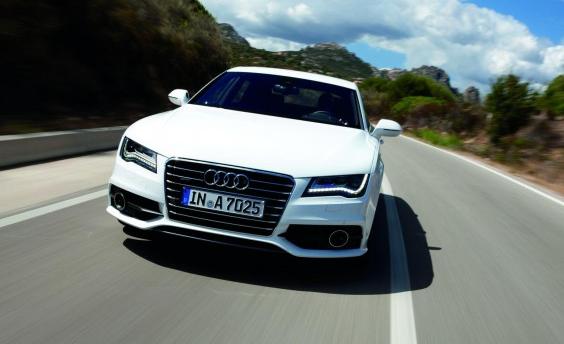
The Audi A7 Sportback will hit the market with four direct-injection V6 engines

Engine 3 liter V6, Aspiration supercharger, HP 300 hp @ 5250 - 6500 rpm, HP/Liter 100 hp per liter, Torque 325 lb-ft @ 2900 - 4500 rpm

Elegance on a grand scale – the Audi A7 Sportback
Audi is targeting a new vehicle class with the A7 Sportback. The large, elegant five-door model combines the emotional character of a grand coupe, the comfort and prestige of a sedan and the active practicality of a station wagon. With its lightweight body, the powerful and efficient V6 engines, the sporty chassis and the advanced assistance and multimedia systems, it sets standards in many fields of technology. The Audi A7 Sportback will roll into dealerships in the fall, with prices starting at €51,650.

At a glance
Design and body
Elegant coupe design with four doors and a large, wide-opening luggage compartment hatch that opens and closes electrically (standard)
4.97 meters (16.31 ft) long; variable luggage compartment with up to 1,390 liters (49.09 cu ft) of capacity
LED headlights optional; bi-xenon headlights and LED tail lights standard
Lightweight body, large percentage of aluminum and high-strength steels

Interior and controls
-- Elegant, modern lines, a craftsman’s level of workmanship, elegant colors and materials, novel layered wood inserts
-- Start-stop button standard
-- Front seats optionally with ventilation and massage function
-- MMI radio operating system standard; head-up display available as an option
-- Optional MMI navigation plus system with touchpad and large 8-inch display, Internet services from Google, Audi music interface and Bang & Olufsen Advanced Sound
System
-- Optional ambient lighting package with LED technology in the roof module, in the center console ringed with lights and the illuminated door sill trims
-- Advanced safety and assistance systems such as Audi pre sense, adaptive cruise control with stop & go function, Audi active lane assist, night vision assistant, speed limit display and park assist system
-- Highly efficient, fuel-saving climate control system

Engines
-- Four V6 engines – two powerful and highly efficient gasoline and TDI units each with power ranging from 150 kW (204 hp) to 220 kW (300 hp)
-- All engines with thermal management, start-stop system and energy recovery
-- 3.0 TDI with 150 kW (204 hp) and multitronic (front-wheel drive) with just 139 g CO2/km (223.70 g/mile

Drivetrain
-- Front-wheel drive with multitronic; quattro all-wheel drive combined with seven-speed S tronic
-- quattro with crown-gear center differential and torque vectoring
-- quattro with sport differential for the active distribution of power at the rear axle available as an option

Chassis
-- Sophisticated chassis construction, aluminum control arms
-- Newly developed, high-efficiency electromechanical power steering
-- Audi drive select assistance system comes standard
-- Optionally available adaptive air suspension with controlled damping
18-inch to 20-inch wheels, powerful brakes

Engines
The Audi A7 Sportback will hit the market with four direct-injection V6 engines: two gasoline units and two diesels. Ranging from 150 to 220 kW (204 to 300 hp), the engines propel the large five-door coupe smoothly and powerfully, with astonishing efficiency. The 3.0 TDI multitronic with front-wheel drive and 150 kW (204 hp) consumes on average just 5.3 liters of fuel per 100 km (44.38 US mpg), corresponding to CO2 emissions of just 139 g per km (223.70 g/mile). No competitor in this class can boast figures this low. All engines use Audi’s innovative thermal management system, a recuperation system and a start-stop system.

Audi has thoroughly revised the two gasoline engines, the 2.8 FSI and the 3.0 TFSI, with respect to internal friction and thermal management. The engines quickly come up to operating temperature following a cold start. A separate heat exchanger is used to also bring the transmission up to temperature. The 2.8 FSI has an additional efficiency technology on board – the Audi valvelift system varies the stroke of the intake valves as needed. This enables the engine to breathe with significantly reduced throttle losses in many partial-load ranges, boosting torque and reducing fuel consumption.

The 2.8 FSI produces 150 kW (204 hp) and 280 Nm (206.52 lb-ft) of torque at 5,250 rpm. The torque is available from 3,000 to 5,000 rpm. Audi pairs this engine with the S tronic transmission and quattro all-wheel drive. The A7 Sportback 2.8 FSI quattro sprints from zero to 100 km/h (62.14 mph) in 8.3 seconds and has a top speed of 235 km/h (146.02 mph). It consumes just 8.0 liters of fuel per 100 km (29.40 US mpg) on average, which corresponds to only 187 grams of CO2/km (300.95 g/mile).

With the top gasoline engine, the 3.0 TFSI, a supercharger compresses the intake air for improved efficiency and performance. The three-liter V6 produces 220 kW (300 hp) between 5,250 and 6,500 rpm, and delivers 440 Nm (324.53 lb-ft) of torque between 2,900 and 4,500 rpm. The supercharged engine, which in Europe is mated to the S tronic and the quattro powertrain, gives the five-door coupe the performance of a sports car.

The standard sprint takes just 5.6 seconds, and top speed is limited to 250 km/h (155.34 mph). Standard fuel consumption is just 8.2 liters per 100 km (28.68 US mpg), corresponding to 190 grams CO2 per km (305.78 g/mile).
The 3.0 TDI is available in two versions. The more powerful version of the big diesel, which has been completely redesigned, produces 180 kW (245 hp) between 4,000 and 4,500 rpm and 500 Nm (368.78 lb-ft) of torque between 1,400 and 3,250 rpm. The S tronic and quattro all-wheel drive are also standard here. Acceleration from 0 to 100 km/h (62.14 mph) takes 6.5 seconds and top speed is limited to 250 km/h (155.34 mph). Efficiency is impressive: just 6.0 liters of fuel per 100 km (39.20 US mpg) on average, which corresponds to only 158 grams of CO2/km (254.28 g/mile).

The second version of the 3.0 TDI, which will follow somewhat later, does even better in this discipline. It produces 150 kW (204 hp) between 3,750 and 4,500 rpm. With front-wheel drive and the stepless multitronic automatic transmission, it really flaunts its efficiency: 139 grams CO2 per km (223.70 g/mile) and an average fuel consumption of 5.3 liters per 100 km (44.38 US mpg) are groundbreaking figures. With the new Efficiency TDI, the front-wheel drive A7 Sportback accelerates from 0 to 100 km/h (62.14 mph) in 8.1 seconds and reaches a top speed of 234 km/h (145.40 mph).

With the 3.0 TDI with 150 kW (204 hp), the timing of the cam shafts, the turbocharger and the common rail system with an injection pressure of 2,000 bar have been designed specifically for low fuel consumption. With front-wheel drive, the V6 diesel produces 400 Nm (295.02 lb-ft) of torque. The power is continuously available between 1,250 and 3,500 rpm. With quattro all-wheel drive, it is 450 Nm (331.90 lb-ft) of torque that is available between 1,250 and 3,500 rpm.
»»  READMORE...

Minggu, 24 Juli 2011

2012 The Audi R8 GT Spyder delivers breathtaking performance

The Audi ultra lightweight technology is the key to the R8 GT Spyder’s weight of just 1,640 kilograms (3,615.58 lb). That’s 85 kilograms (187.39 lb) less than its technical basis, the R8 Spyder 5.2 FSI quattro. The Audi Space Frame (ASF) body, consisting of cast nodes, extruded sections and aluminum panels, accounts for just 214 kilograms (471.79 lb) of the total weight. The body is assembled predominantly by hand in the R8 workshop at the Neckarsulm plant. Final assembly of the car takes place in the same way.

The engine frame is made of ultra-light magnesium; the long cover over the soft-top compartment and the large side panels at the rear are made of carbon fiber-reinforced polymer (CFRP). CFRP is also used for the modified front spoiler, the fixed rear spoiler and the new rear bumper. Together, these components provide a weight saving of 5.5 kilograms (12.13 lb).
Visual modifications accentuate the styling of the R8 GT Spyder. These include add-on parts in contrasting titanium gray, a front splitter with a dual lip, flics at the sides of the front bumper, red GT badges, round exhaust tailpipes, an enlarged diffuser and dark LED tail lights in a clear-glass design. Audi offers an optional windshield frame in matt CFRP.

Audi engineers also trimmed weight from the technical components in the area of the transmission, wheels and brakes. In the interior, the bucket seats alone, with their chassis of glass fiber-reinforced polymer (GFRP), saved 31.5 kilograms (69.45 lb) of weight.
Prodigious power: the drivetrain
The performance offered by the new top-of-the-line model in the R8 family is formidable. The 5.2-liter V10 with an aluminum crankcase draws its fuel from an FSI direct injection system. Dry-sump lubrication ensures a reliable supply of oil even under maximum lateral or straight-line acceleration.

With its modified electronic management, the long-stroke engine produces 540 Nm (398.28 lb-ft) of torque at 6,500 rpm, and its peak output is 412 kW (560 hp). Each unit of horsepower has only 2.93 kilograms (6.46 lb) to move. The R8 GT Spyder catapults from zero to 100 km/h (62.14 mph) in 3.8 seconds and reaches a top speed of 317 km/h (196.97 mph). In every situation, the engine impresses with its thrust and bite – and that unmistakable sound of an Audi ten-cylinder.
The R8 GT Spyder comes standard with an automated six-speed R tronic transmission with two fully automatic modes. In the additional manual mode, the driver can shift gears using the paddles on the steering wheel or by flicking the joystick. At high load and revs, gear changes take only one-tenth of a second. The launch control program manages the starting sprint with high engine speed and precision-control of the tire slip.
»»  READMORE...

Rabu, 06 April 2011

All-new Audi A7 2012

While the coupe design of the Audi A7 attracts the eye, the aluminum-hybrid lightweight construction, with aluminum body panels and a steel frame, provides excellent handling, safety and fuel economy. The 3.0L TFSI V6 supercharged engine generates 310 horsepower and is paired with an 8-speed Tiptronic automatic transmission yielding impressive fuel economy ratings (18 mpg in the city and 28 mpg on the highway, according to the U.S. EPA, for a combined fuel economy rating of 22 mpg) with quattro all-wheel drive standard.

The A7 introduces an available Audi-first headup Display with a high-resolution, full-color display, as well as many innovative technologies which were recently introduced in the Audi A8 flagship, including available full LED headlights, Night vision assistant, Audi pre sense plus and the unmatched Bang & Olufsen® Advanced Audio System, which delivers 1,300 watts of audio bliss through 15 perfectly tuned speakers.

U.S. pricing for all-new Audi A7 starts at $59,250.
»»  READMORE...

Selasa, 09 November 2010

Audi Q7 2011

Q7 family. The Q7 3.0 TDI offers 150 kW (204 hp) while consuming an average of just 7.2 liters of diesel per 100 km (32.67 miles per U.S.gallon) – better than all direct competitors. At the same time, a 3.0 liter V6 drives this large SUV powerfully and smoothly. An eight-speed tiptronic and quattro permanent all-wheel drive round out the luxurious drivetrain.

The new V6 TDI in the Q7 is a high-tech engine. It weighs far less than 200 kilograms (440.92 lb) and extensive measures minimize internal friction. Innovative thermal management – a new feature of many Audi engines – is particularly complex in the 3.0 TDI. The crankcase and the cylinder heads have separate cooling water circuits; coolant is not circulated within the block while the engine is warming up.

The EU 5 classification for this new entry model in the Q7 family will come as no surprise, just like its high fuel efficiency. On average, it needs 7.2 liters per 100 km (32.67 miles per U.S. gallon). And its CO2 equivalent is just 189 grams per km (304.17 grams per mile) – no other large SUV from a European brand boasts such a low value. The efficient TDI delivers 150 kW (204 hp). Its maximum torque becomes available just above the idling point: 450 Nm (331.90 lb-ft) remain constant between 1,250 and 2,750 rpm.

This large SUV accelerates from 0 to 100 km/h (62.14 mph) in 9.1 seconds. In the version with an optional air suspension, it reaches a top speed of 205 km/h (127.38 mph); with steel suspension, 202 km/h (125.52 mph).

The Q7 3.0 TDI with 150 kW (204 hp) offers the same power transmission as all other models in this line. The new and efficient eight-speed tiptronic – with its high overall gear ratio – delivers torque to the quattro permanent all-wheel drive, which has a sporty rear-end bias. Double wishbones made of aluminum guide all four wheels; the chassis delivers great agility and stability. An off-road mode and a hill-descent assistant aid off-road driving.

With a wheelbase measuring 3.00 meters (9.84 feet) and an overall length of 5.09 meters (16.70 feet), the interior offers plenty of room. Audi offers the Q7 with five, six or seven seats. The luggage compartment offers as much as 2,035 liters of capacity (71.87 cubic ft). This new entry model’s standard equipment package includes two-zone deluxe automatic air conditioning, a high-beam assistant, and an MMI radio multimedia interface.

Despite a generous equipment package,Justify Full this model line’s new entry model costs just 51,800 euros in Germany. This basic price makes the Q7 more affordable than all of its direct competitors.

»»  READMORE...

Senin, 01 November 2010

Audi R8 Spark Eight Eisenmann 2011

Eisenmann has long been the acme of superior performance exhaust systems. For the first time the exhaust specialist has transformed an entire vehicle. The highest standards, which are hallmarks of Eisenmann, also apply to the carbon aerodynamic package, the alloy wheels, the chassis, and of course the exhaust system. This converts the Audi R8 into the Spark Eight by Eisenmann.


Not only does the aerodynamic package contribute to its ultimate visual effect, it also improves the functionality of the super sports car from Ingolstadt. The components significantly improve the driving dynamics and the load distribution between front and rear axle. The new carbon outfit includes the spoiler with grille and fins (7800 Euro including VAT), the brake cooling chambers (1260 Euro), the front splitter (1800 Euro), the rear spoiler with grille (4800 Euro), and the rear diffuser (3800 Euro).
It goes without saying that exhaust systems are the domain of Eisenmann. The Spark Eight by Eisenmann is fitted with a performance stainless steal system, with a gigantic tailpipe exit in the center of the rear spoiler (4600 Euro). This warrants a one-of-a-kind visual effect. Thanks to the flap control system, sound and optimal performance can be controlled with the push of a button. As an alternative Eisenmann offers an exhaust system with four stainless steel tailpipes (3800 Euro) that can be combined with the standard rear spoiler. The retro-classic intake funnel (1200 Euro) and the two oval tailpipes (1000 Euro) provide the look of the R10.

Eisenmann also ensures that the improved chassis matches the upgrade of visual effect and sound. The new shock absorbers with four performance springs (3850 Euro) increase the driving dynamic for even more agile handling characteristics. The 235/35 (front) and 315/30 (rear) tyres mounted on 8.5×19 inch alloy wheels ensure a solid grip (complete set available for 7300 Euro).

For the Spark Eight by Eisenmann, visual appearance, sound and performance enter into a perfect symbiosis. All of the above is based on experience Eisenmann has amassed in motoring. Many years of research and development for racetracks and motorways alike have merged into an unrivaled project.


»»  READMORE...