Senin, 21 Maret 2011

BMW M3 GTS 2011 - First Drive Review


With the launch of the E92 BMW M3 now almost three years behind us, we’ve resorted to testing tuner and racing versions of the car for our M3 fix. Thankfully, BMW is introducing a lighter, more powerful version for 2011, so we had an excuse once again to slide behind the wheel. Awesome side note: BMW M GmbH chief Kay Segler says the internal code name for the M3 GTS was Jägermeister, a reference to the famous German digestif and frat fuel with a history of sponsoring motorsports.

Segler and crew came about the weight loss the easy way: They removed stuff. There are no rear seats, the center console and the door trim have shed a few pounds, and even air conditioning is optional. The back window and the rear side glass have been replaced with polycarbonate (the front windows and the windshield remain glass). The M3's audio system was discarded, and so was a lot of sound insulation. The only music comes from the ultralight titanium exhaust system.

Weight loss is less than what we had expected—just over 100 pounds. Considering that’s partly because the standard roll bar and the fire extinguisher eat up some of the savings, though, we’re okay with it. Although three-point seatbelts come installed in the car, six-point harnesses are included as well.

Power rises from 414 hp to 444, arriving at the same 8300 rpm as in the regular M3. Maximum torque rises from 295 lb-ft at 3900 rpm to 325 lb-ft at 3750 rpm. It wasn’t easy, though: M had to bore the engine from 4.0 to 4.4 liters, a lot of effort to gain 30 hp and 30 lb-ft.

Specifications

VEHICLE TYPE: front-engine, rear-wheel-drive, 2-passenger, 2-door coupe

PRICE AS TESTED: $145,280

ENGINE TYPE: DOHC 32-valve V-8, aluminum block and heads, port fuel injection

Displacement: 266 cu in, 4361 cc
Power (SAE net): 444 bhp @ 8300 rpm
Torque (SAE net): 325 lb-ft @ 3750 rpm

TRANSMISSION: 7-speed dual-clutch automated manual

DIMENSIONS:
Wheelbase: 108.7 in Length: 182.9 in
Width: 71.0 in Height: 54.6 in
Curb weight (mfr’s est): 3550 lb

PERFORMANCE (C/D EST):
Zero to 60 mph: 3.7 sec
Standing ¼-mile: 12.0 sec

»»  READMORE...

Jumat, 18 Maret 2011

Speed Bump: Samsung’s Galaxy Phone Gets Upped to 4G

Speed Bump: Samsung’s Galaxy Phone Gets Upped to 4G

It’s official: 2011 is the year of incremental progress. Mobile handsets have settled into a groove featurewise and are now gently nudging their way upward in speed, power and capabilities.

If we’re going to be stuck in a climate of baby steps, at least Samsung’s Galaxy S 4G is an example of baby steps done right.

From the moment I got my mitts on the S 4G, something felt eerily familiar. I’d seen many of its elements before — the unsettlingly light chassis, the glass and faux-chrome accents, and even the flashless 5-MP camera. As it turns out, the feeling of déjà vu was completely warranted.

The S 4G is essentially a mildly tweaked Samsung Vibrant with a couple of extra goodies. For those keeping score, a lot of the Vibrant’s perfectly serviceable features (1-GHz processor, 4-inch 800 x 480 AMOLED screen, 720p video recording) are back.

So, what’s new? Android 2.2, for starters. Also, as the phone’s awkward moniker boasts, this handset brings T-Mobile’s particular brand of 4G (HSPA+) to the fold.

I honestly wasn’t expecting too much given the piecemeal rollout of this next-gen data network, but the difference was noticeable immediately. Heavy hitting image-rich sites like (ahem) Wired.com loaded with virtually no hesitation, and raining down large file downloads from Dropbox produced nary a stutter.

Converting the phone into a hot spot was also one of the more useful data-centric features, though the option is strangely buried within the menu tree. Samsung’s TouchWiz user interface has never been especially appealing, and this is another nail in that coffin.

Yet another addition is the S 4G’s front-facing VGA camera. Though it’s perfectly poised for video conferencing, I was a little underwhelmed by the options on the app side. Getting the service up and running is simple enough thanks to a preloaded Qik app, but the occasional stutter and noticeable lag left a lot to be desired.

Lack of polish aside, I can’t really fault the VGA camera in terms of functionality. I was able to make and receive video calls just fine. They just resembled fireside chats with Max Headroom.


Other goodies include a copy of Inception offered from Samsung’s Media Hub storefront. Normally I’m prone to ignore extras like this entirely, but watching the film on the S 4G uncovered some interesting tidbits. Due to the smart combination of a workhorse battery and a power-sipping display, the film’s hefty 2-hour-28-minute run time only slightly dented the Galaxy’s gas tank.

As the movie finished I noticed that only 20 percent of the battery had been depleted. It’s doubtful that I would ever force myself into a back-to-back four-peat viewing of Inception, but it’s good to know that Samsung realistically views the S 4G as an entertainment device.

If we’ve learned anything over the past year, it’s that incremental improvements are incredibly easy to flub. Even with our lingering gripes with the S 4G, we can’t give the phone too much guff.

Samsung managed to transform an already well-appointed blueprint into an even stronger contender. Sure, it’s not the overwhelmingly overhauled quad-core beast of our dreams. But even incremental progress still counts as progress.

WIRED Stronger iteration of a solid design. Mostly smooth navigation thanks to a humming 1-GHz processor. Great call quality. Awesome battery life and power management. Gorgeous high-def 720p video (in well-lit environments). Ready for downloads and app-tion thanks to an included 16-GB memory card (expandable to 32 GB).

TIRED Accessing the movie storefront requires a tedious login process. Bloatware aplenty. Where’s my HDMI out? HSPA+ service is fantastically fast (where available). 4G to 3G to EDGE handoffs are often slow. White backgrounds often produce the dreaded “screen-door effect.” Froyo is already old hat — give us Gingerbread!

»»  READMORE...

Say hello to the Android smartphone of the year so far: The Samsung Galaxy S2.

Say hello to the Android smartphone of the year so far: The Samsung Galaxy S2.


Android based phones are coming thick and fast this year. So much so, that it is going to make actually choosing one a bit of a minefield. At least that's the case if you haven’t clapped eyes on Samsung’s flagship phone for 2011, the Galaxy S2.
Anyone who is looking for a super-powered mobile phone is going to get it here with the Galaxy S2, which features a beastly 1.2 GHz dual-core processor running of a generous 1GB of RAM. That’s theoretically faster than the super speedy iPad 2 and should give users all the power they are ever going to need.
Obviously a higher spec CPU makes for a power-hungry phone, especially when you consider that the Galaxy S2 screen size has jumped from the original 4-inches to 4.3-inches. Thankfully there is no need to worry about charging in the middle of the day thanks to the display technology which is a Super AMOLED Plus screen that uses a fraction of the power used by a conventional LCD screen and will ensure a least a day’s worth of heavy smartphone use.
To top it all off, there is a monster 8-megapixel camera with LED flash on the back and a 2-megapixel shooter on the front.
All of this will be housed in a ridiculously thin casing that, at just 8.49 millimetres, makes the Galaxy S2 the thinnest phone in its class, even eclipsing the iPhone 4.
The phone will also be running Android Gingerbread, the latest version of the operating system for smartphones and this will provide a silky smooth user interface as well as allowing for the Galaxy’s newest feature called Near Field Communication (NFC).
NFC is an innovative new communications protocol that functions as a data exchange between devices and NFC tags once they are within four feet of each other. This might not seem like a big deal but it will, in the future, facilitate for instant transactions (just wave your phone at the counter and walk out) or even a full medical history that updates itself after every doctors visit or treatment.
It’s heady stuff and is unlikely to become a part of everyday life for another couple of years but if electronics giants like Samsung, Nokia, Sony and Apple are including it in their future plans, expect to see this one fly.
For our money, the Samsung Galaxy S2 is the must-have Android phone of the year so far. As to when Samsung actually get around to releasing it is anyone’s guess and but we reckon that Samsung is going to drop this Apple-baiting bomb very near to the summer launch of the iPhone 5.

»»  READMORE...

Kamis, 17 Maret 2011

Samsung Fabricates New Apple A5 Chip

Samsung Fabricates New Apple A5 Chip Samsung Fabricates New Apple A5 Chip

iPad 2 by adamjackson1984 / Flickr (CC BY-ND)

Despite reports that Apple might have tapped Taiwan Semiconductor Manufacturing Company (TSMC) to make Apple’s new A5 processor, Samsung fabricated the A5 processors currently powering the recently-released Apple iPad 2, a recent teardown by United Business Media’s (UBM) TechInsights reveals.

The conclusion was drawn by the firm after comparing the results of their teardown of the Apple A5 chip with previous results from when they studied Apple’s A4 processor.

Allan Yogasingam, a technical marketing manager for TechInsights, told UBM’s EE Times that TechInsight can “say with 100 percent certainty that this is a Samsung-made chip.”

According to TechInsights, which analyzed an A5 chip which came with an iPad 2 using optical die and SEM cross-section images, the A5 chip is able to use low power DDR2 DRAM memory and used the 45-nanometer fabrication process of Samsung.

According to the report by EE Times, a study done by IO Snoops revealed that the clock speeds for the A5 chip is also varied at about 890 MHz to 1 GHz.

In light of this, the iPad 2 is said to be utilizing advanced power management to regulate clock speeds of the A5 processor depending on how resource-demanding running applications are.

»»  READMORE...

Minggu, 13 Maret 2011

Lexus CT 200h 2011


Lexus Gets Young, Fun and Green
The 2011 Lexus CT 200h at a press event held in Delray Beach, Florida, a town that's the less exclusive neighbor to Boca Raton, that famously moneyed Florida retirement enclave. It's a fitting location, given that the CT 200h aims to be the affordable player in the Lexus lineup. With a sub-$30,000 price (the least expensive in the Lexus family) and frugal fuel efficiency, the CT 200h stands poised to beckon fresh blood to the brand's silver-haired customer base.

Lexus executives firmly refer to the CT 200h as a five-door compact, but as we take our first look at the car in the bright Florida sun, its sheet metal tells a humbler story. This is a hatchback, no two ways about it, a car meant to occupy the space in your imagination between a Mazda 3 five-door and an Audi A4 Avant.

It's also a hybrid, the fifth in the Lexus family, with the same powertrain as the Toyota Prius. As we'd expected, this translates into fuel economy that's the best in the premium compact segment, but what we didn't expect is how much fun the CT 200h is to drive. Though it's no overachiever in straight-line acceleration, this Lexus feels tightly buttoned up, with sharp, responsive steering. Hybrids aren't usually this entertaining, least of all those that share parts with a Prius.

Thin but diverse, the herd of premium compacts includes the lively BMW 1 Series, the handsome Volvo C30 and the luxurious, eco-minded Audi A3 TDI. Less pricey than most of its rivals and more frugal at the pump than all, the Lexus CT 200h distinguishes itself as a value-oriented luxury car that just happens to be a hybrid.


Who should consider this vehicle
The 2011 Lexus CT 200h is a good pick for shoppers who want Lexus prestige without sticker shock and steep fuel bills. It's also a solid bet for those in search of a less ubiquitous, more high-end alternative to the frugal Prius.


»»  READMORE...

Sabtu, 12 Februari 2011

Infiniti G-Sedan 2011

2011 Infiniti G-Sedan
(2.5L V6 7-speed Automatic)


Design/Fit and Finish
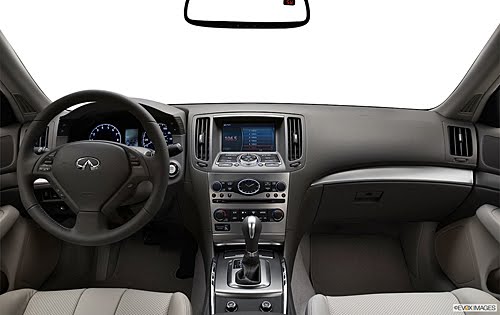
The Infiniti G25's 2011 pleasantly familiar exterior combines with modern details that seem appropriate for a vehicle that touts its high-tech credentials. Wraparound headlights and a contoured grille are Infiniti hallmarks, as are the muscular bulges on the hood. Inside the cabin, the design is slightly more subdued and austere. The rounded dash and a good portion of other surfaces in the cabin are soft to the touch and well grained. Elements are tightly fitted and devoid of squeaks and creaks.


Who should consider this vehicle
Unless power and performance are primary concerns for your luxury sport sedan decision, the 2011 Infiniti G25 is an excellent choice. There's more than enough power for the average driver, in a well-mannered package. Plus, buyers can save some cash up front, as well as down the road in fuel economy compared to the Infiniti G37.


The venerable BMW 3 Series is still the leader in this segment of sporting luxury sedans, yet the Infiniti G25 is worth serious consideration, much like the Audi A4 2.0T with its 211-hp, turbocharged four-cylinder engine — a car with which this Infiniti has much in common, from its power to its price. On the more luxurious side of the spectrum, the Hyundai Genesis, Lexus IS and Mercedes-Benz C-Class could be of interest, but most of these can't compete with the Infiniti's driver engagement or its agreeable bottom line.

Performance
Powering the 2011 Infiniti G25 is a 2.5-liter V6 that produces 218 hp and 187 pound-feet of torque. A seven-speed automatic is the only transmission offered, but buyers can choose rear- or all-wheel drive.

In Edmunds testing, our rear-wheel-drive G25 accelerates from a standstill to 60 mph in 8.0 seconds. While this is 2.6 seconds slower than the more powerful G37 (something like a light-year in sport-sedan time), the G25 nevertheless doesn't feel weak by comparison. The 2.5-liter V6 has an energetic character and revs quickly, even as it offers a smoother feel than the 3.7-liter V6.


»»  READMORE...

Kamis, 10 Februari 2011

Mazda5 2011


The all-new Mazda5 is fitted with a newly-developed 2.0-litre DISI1 petrol engine equipped with i-stop, and a six-speed manual transmission with gear ratios specific to this version. This new direct-injection petrol offers linear and smooth performance characteristics and is fun to drive. It is also one of the most frugal and clean C-MAVs on the market, achieving approximately 15 percent reduction in CO2 emissions compared to the 2.0-litre petrol it replaces. The gasoline line-up features a 1.8-litre engine with a six-speed manual transmission as well.
The all-new 2011 Mazda5 will go on sale in Europe this fall.


»»  READMORE...